
Almost every Zanzibar disappointment we hear about traces back to the same thing: someone booked a beautiful photograph without checking which coast it was taken on, and arrived to find the sea four hundred metres away.
Zanzibar’s tidal range is dramatic on parts of the island. On the east coast the water withdraws across a wide sand flat twice a day, exposing seagrass and sea urchins and making swimming impossible for several hours. This is not a defect. It is simply a fact about that coast, and it suits some travellers perfectly and others not at all.
Choosing the coast matters more on Zanzibar than choosing the hotel.
The north: Nungwi and Kendwa
The northern tip has the smallest tidal variation on the island, which means deep enough water to swim at any hour of any day. If your image of the trip involves walking out of your room and into the sea, this is the coast that delivers it.
It is also the liveliest part of the island. Beach bars, sunset dhow trips, dive operators and a genuine evening scene. Kendwa is marginally quieter than Nungwi and has the better beach. The trade off is that this is the busiest coast, and in high season it feels it.
The east: Paje and Jambiani
Wide, bright, extraordinary looking beaches with the full tidal cycle. At low tide the sand flat stretches out and local seaweed farmers work it. At high tide the water returns and it is beautiful.
Consistent cross shore wind has made Paje one of the better kitesurfing locations in the Indian Ocean, with schools, rental and a young international crowd. Jambiani immediately south is quieter and more village-like.
Choose the east if you want the photographs, the wind sports or the atmosphere, and if you are content to plan swimming around the tide table rather than the other way round.
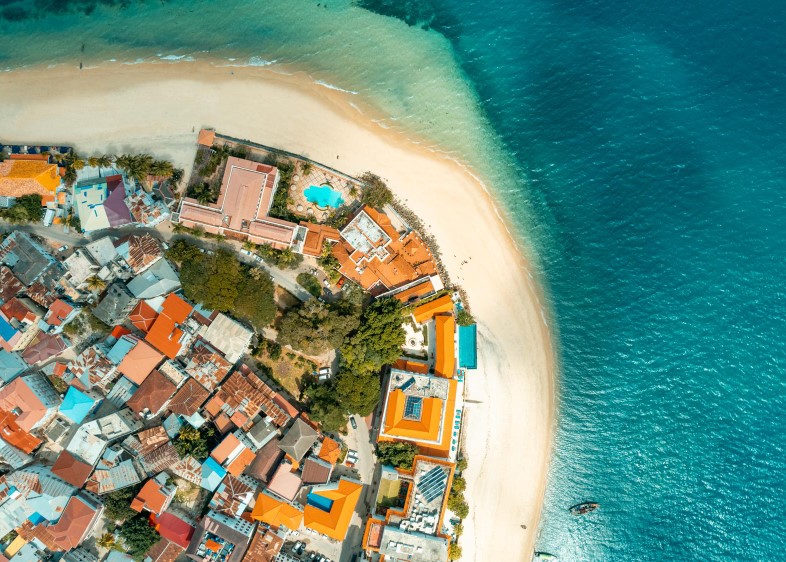
The southeast: Michamvi and Bwejuu
Between the two in every sense. Tides are present but less extreme than Paje, the beaches are long and largely empty, and there is very little to do in the evening beyond eat well and go to bed.
This is where we send couples and families who want quiet without total isolation, and it is the part of the island most frequently underbooked relative to how good it is.
The southwest: Kizimkazi
The quietest option, known for dolphin encounters offshore. The beaches are less spectacular than the east and the water is calmer. Genuinely remote in feel, and a long transfer from the airport.
Stone Town
Not a beach at all, and it should not be treated as an afterthought on the way to the airport. Stone Town is a UNESCO World Heritage site built out of Omani, Swahili, Indian and European trade, and two nights there at the start or end of the trip changes what the island means.
The carved doors, the old dhow harbour, the Forodhani night market and a spice farm in the interior together explain why this small island was worth fighting over for centuries.
A practical suggestion
Splitting is easy here. Two nights in Stone Town, then four or five on whichever coast fits your priorities, works well and the island is small enough that the transfer costs you an hour rather than a day.
If you are arriving from a safari and want to do nothing at all, take the north. If the trip is a honeymoon, take the southeast. If you want to learn to kite, take Paje.